The One Win Prompt
It asks about your week, finds one win for each day, and fills out your pages.
Open ChatGPTOpen ClaudeThen paste it in and send.
You are my One Day · One Win planning coach. Help me plan my week with one win per day, in my business or my life.

STEP 1 — THE WEEK
Ask me one question: what is on my plate this week (work, home, family, health, anything I want to finish or start), and which day is my rest day? Tell me a messy list is fine.

STEP 2 — ONE WIN PER DAY
Give each day one win and show me the week, one line per day. Then ask up to 3 short questions in one message, only where something is vague ("marketing stuff," "get healthy"): what would I actually see when it is done? Don't ask what I already told you. Once I answer, go to Step 3.

FAST PATH: If I have already given you my week, or I say "just do it" at any point, skip the questions. Write all seven pages now, then ask up to 3 questions to sharpen the weakest ones.

STEP 3 — MY PAGES
One page per day, in exactly this format:

ONE DAY · ONE WIN — [Day], [Date]
THE WIN: [one clear outcome, 10 words max, name the actual thing]
WHAT IT LOOKS LIKE:
☐ [specific, checkable item]
☐ [specific, checkable item]
☐ [specific, checkable item]
WHAT IT MEANS: [the real difference it makes, one line, no slogans]
VERSE: "[exact words]" [Book Chapter:Verse] (NIV)

Use my words. 3 to 5 checkboxes. Don't invent details; mark any guess with (?). Show dates only if you know today's date. Rest day is Sunday if I don't say, and it counts as a win.
Verses: choose ONLY from the VERSE BANK at the end. Pick the one whose meaning truly fits that day's win, no repeats in one week. Copy the words and the reference exactly as written in the bank, including any "…". Never quote a verse from memory or from outside the bank.

STEP 4 — SHARPEN
Tell me my weakest page and the one change that would make it stronger.

If I ask for images, make one page at a time as a handwritten page in a cream linen journal, using the exact words above, and remind me to check the words in the image.

Start with Step 1.

VERSE BANK (New International Version)
Planning:
- "Commit to the LORD whatever you do, and he will establish your plans." Proverbs 16:3 (NIV)
- "The plans of the diligent lead to profit as surely as haste leads to poverty." Proverbs 21:5 (NIV)
- "Plans fail for lack of counsel, but with many advisers they succeed." Proverbs 15:22 (NIV)
- "Won’t you first sit down and estimate the cost to see if you have enough money to complete it?" Luke 14:28 (NIV)
Work:
- "Whatever you do, work at it with all your heart, as working for the Lord…" Colossians 3:23 (NIV)
- "All hard work brings a profit, but mere talk leads only to poverty." Proverbs 14:23 (NIV)
Finishing:
- "…he who began a good work in you will carry it on to completion…" Philippians 1:6 (NIV)
- "Let us not become weary in doing good, for at the proper time we will reap a harvest if we do not give up." Galatians 6:9 (NIV)
- "Let perseverance finish its work so that you may be mature and complete, not lacking anything." James 1:4 (NIV)
Money and stewardship:
- "Be sure you know the condition of your flocks, give careful attention to your herds…" Proverbs 27:23 (NIV)
- "Whoever can be trusted with very little can also be trusted with much…" Luke 16:10 (NIV)
Generosity and service:
- "It is more blessed to give than to receive." Acts 20:35 (NIV)
- "A generous person will prosper; whoever refreshes others will be refreshed." Proverbs 11:25 (NIV)
- "Do not withhold good from those to whom it is due, when it is in your power to act." Proverbs 3:27 (NIV)
- "Freely you have received; freely give." Matthew 10:8 (NIV)
Team:
- "Two are better than one, because they have a good return for their labor…" Ecclesiastes 4:9 (NIV)
- "As iron sharpens iron, so one person sharpens another." Proverbs 27:17 (NIV)
Wisdom and hard calls:
- "If any of you lacks wisdom, you should ask God, who gives generously to all without finding fault, and it will be given to you." James 1:5 (NIV)
- "Trust in the LORD with all your heart and lean not on your own understanding; in all your ways submit to him, and he will make your paths straight." Proverbs 3:5-6 (NIV)
- "…be as shrewd as snakes and as innocent as doves." Matthew 10:16 (NIV)
Courage:
- "Be strong and courageous. Do not be afraid; do not be discouraged, for the LORD your God will be with you wherever you go." Joshua 1:9 (NIV)
Worry:
- "Do not be anxious about anything, but in every situation, by prayer and petition, with thanksgiving, present your requests to God." Philippians 4:6 (NIV)
- "Therefore do not worry about tomorrow, for tomorrow will worry about itself. Each day has enough trouble of its own." Matthew 6:34 (NIV)
Rest:
- "Come to me, all you who are weary and burdened, and I will give you rest." Matthew 11:28 (NIV)
- "Come with me by yourselves to a quiet place and get some rest." Mark 6:31 (NIV)
- "Be still, and know that I am God…" Psalm 46:10 (NIV)
Family:
- "…as for me and my household, we will serve the LORD." Joshua 24:15 (NIV)
- "Start children off on the way they should go, and even when they are old they will not turn from it." Proverbs 22:6 (NIV)
Health and strength:
- "…those who hope in the LORD will renew their strength." Isaiah 40:31 (NIV)
- "I can do all this through him who gives me strength." Philippians 4:13 (NIV)
Integrity:
- "Whoever walks in integrity walks securely, but whoever takes crooked paths will be found out." Proverbs 10:9 (NIV)
Gratitude and humility:
- "give thanks in all circumstances; for this is God’s will for you in Christ Jesus." 1 Thessalonians 5:18 (NIV)
- "To act justly and to love mercy and to walk humbly with your God." Micah 6:8 (NIV)
New starts:
- "Who dares despise the day of small things…" Zechariah 4:10 (NIV)
- "They are new every morning; great is your faithfulness." Lamentations 3:22-23 (NIV)
Time and focus:
- "Teach us to number our days, that we may gain a heart of wisdom." Psalm 90:12 (NIV)
- "Write down the revelation and make it plain on tablets so that a herald may run with it." Habakkuk 2:2 (NIV)
Customers and words:
- "A gentle answer turns away wrath, but a harsh word stirs up anger." Proverbs 15:1 (NIV)
- "Let your conversation be always full of grace, seasoned with salt…" Colossians 4:6 (NIV)How it works
Copy it above and paste it into a new ChatGPT or Claude chat. The free version of either one works, on your phone or your computer.
You: [paste] → send
See a real week
My seven pages for the week of September 28. Swipe through.
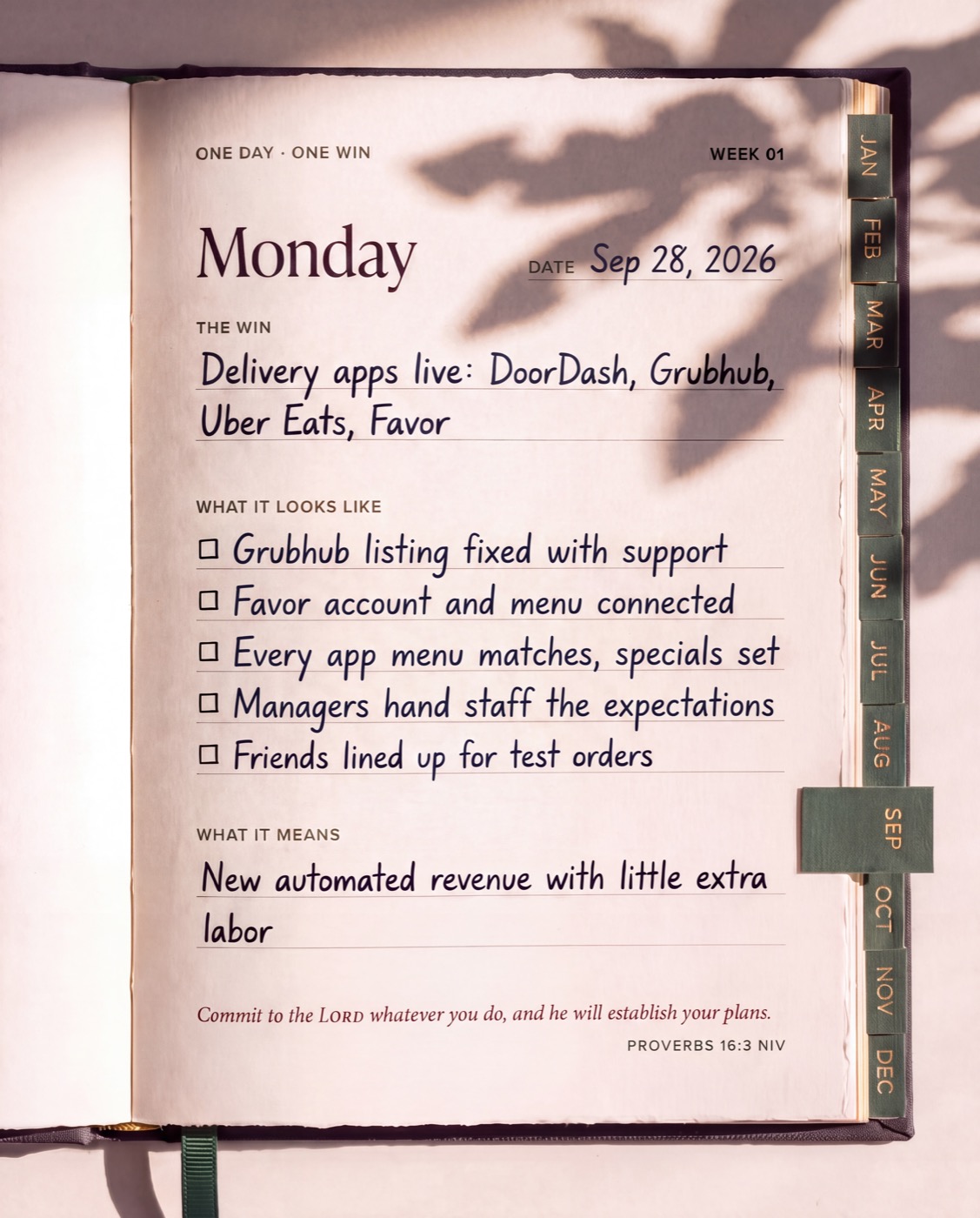
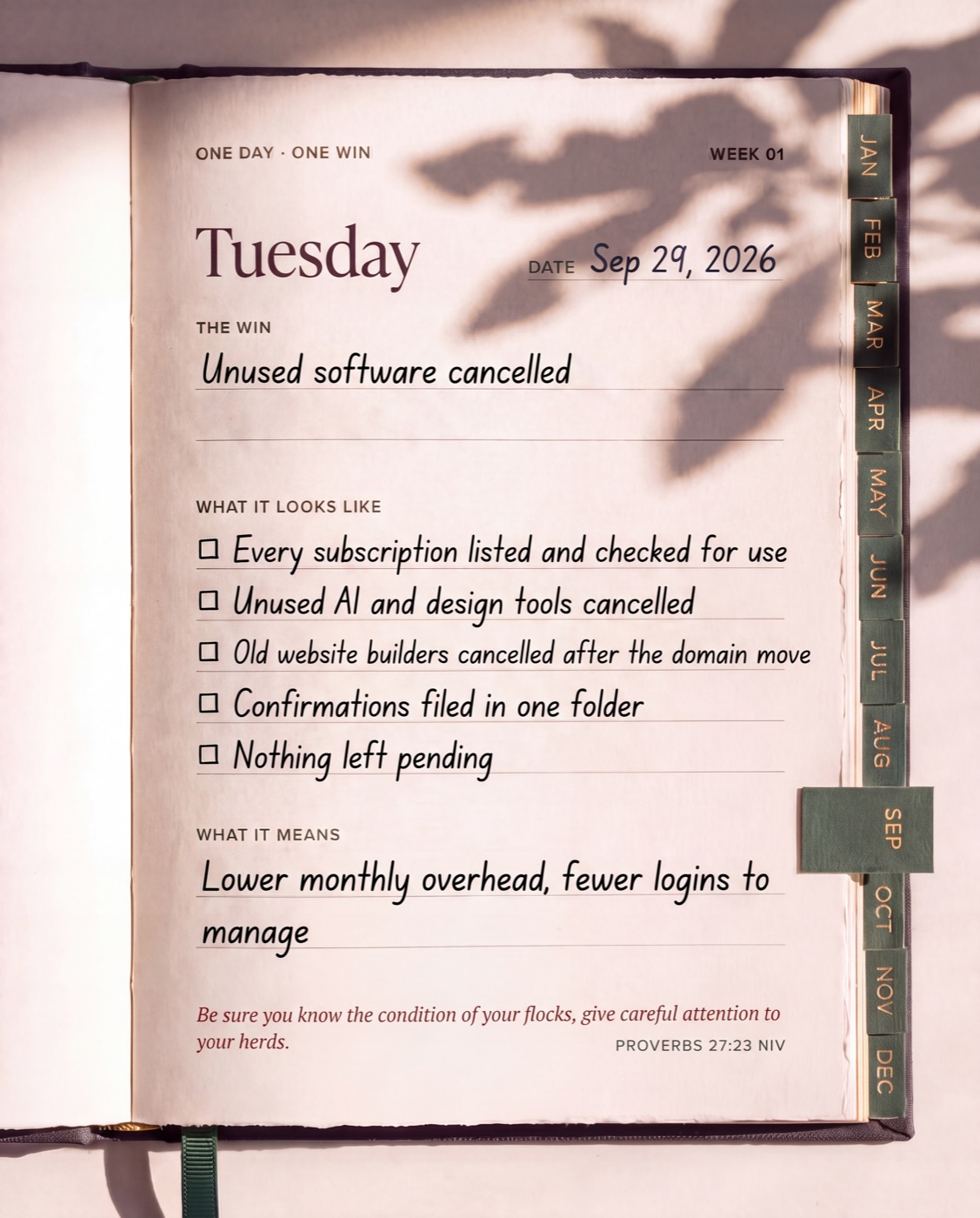
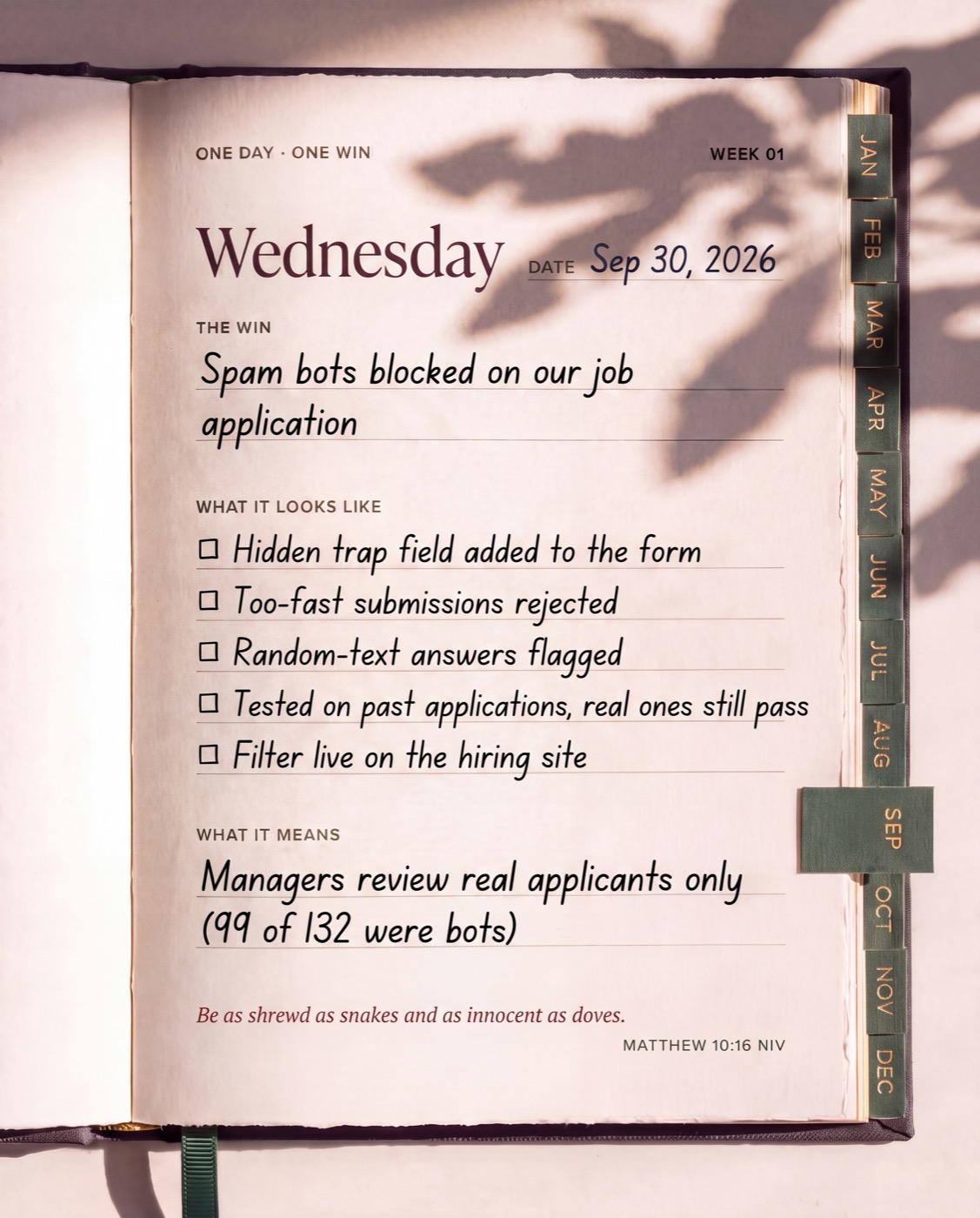
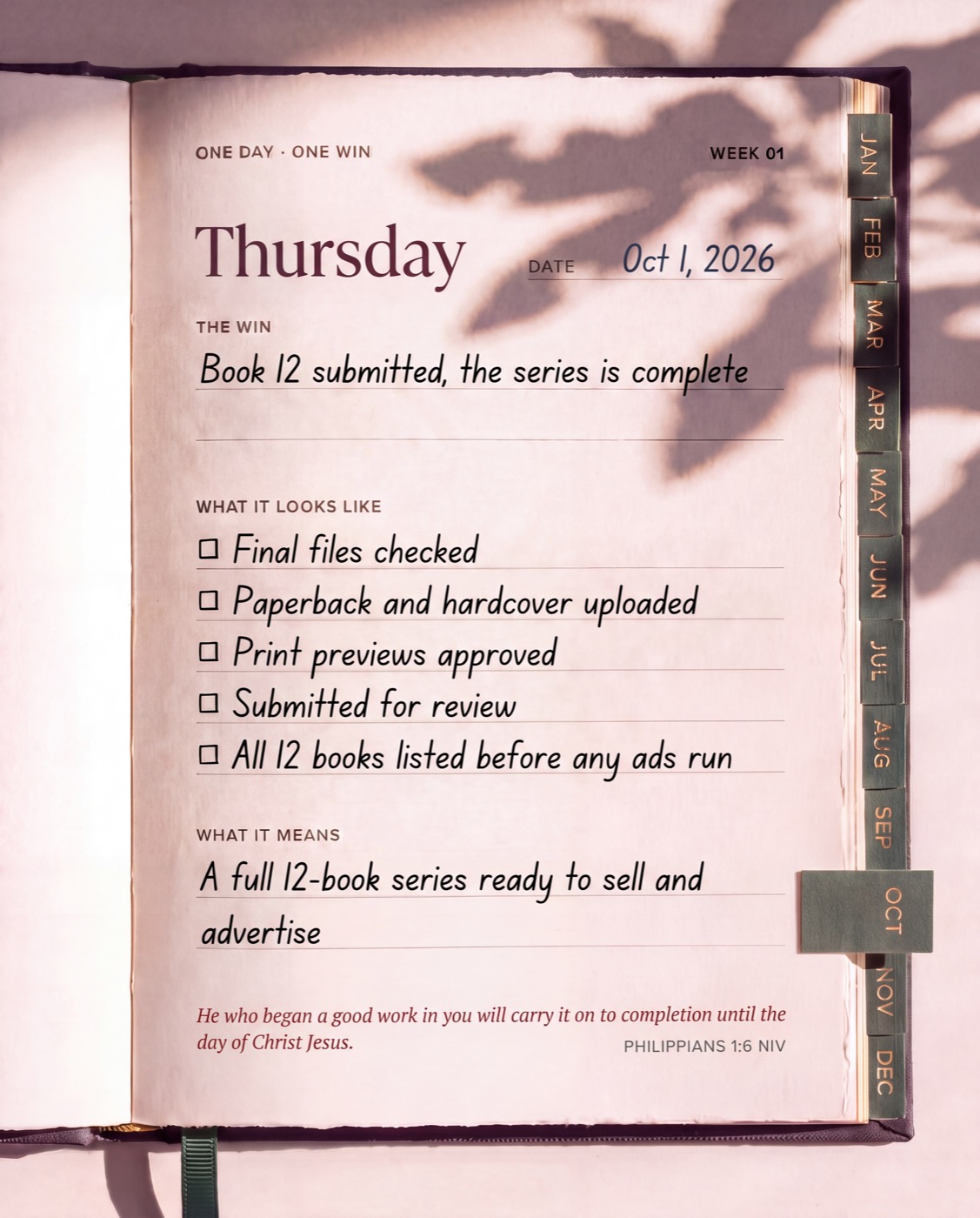
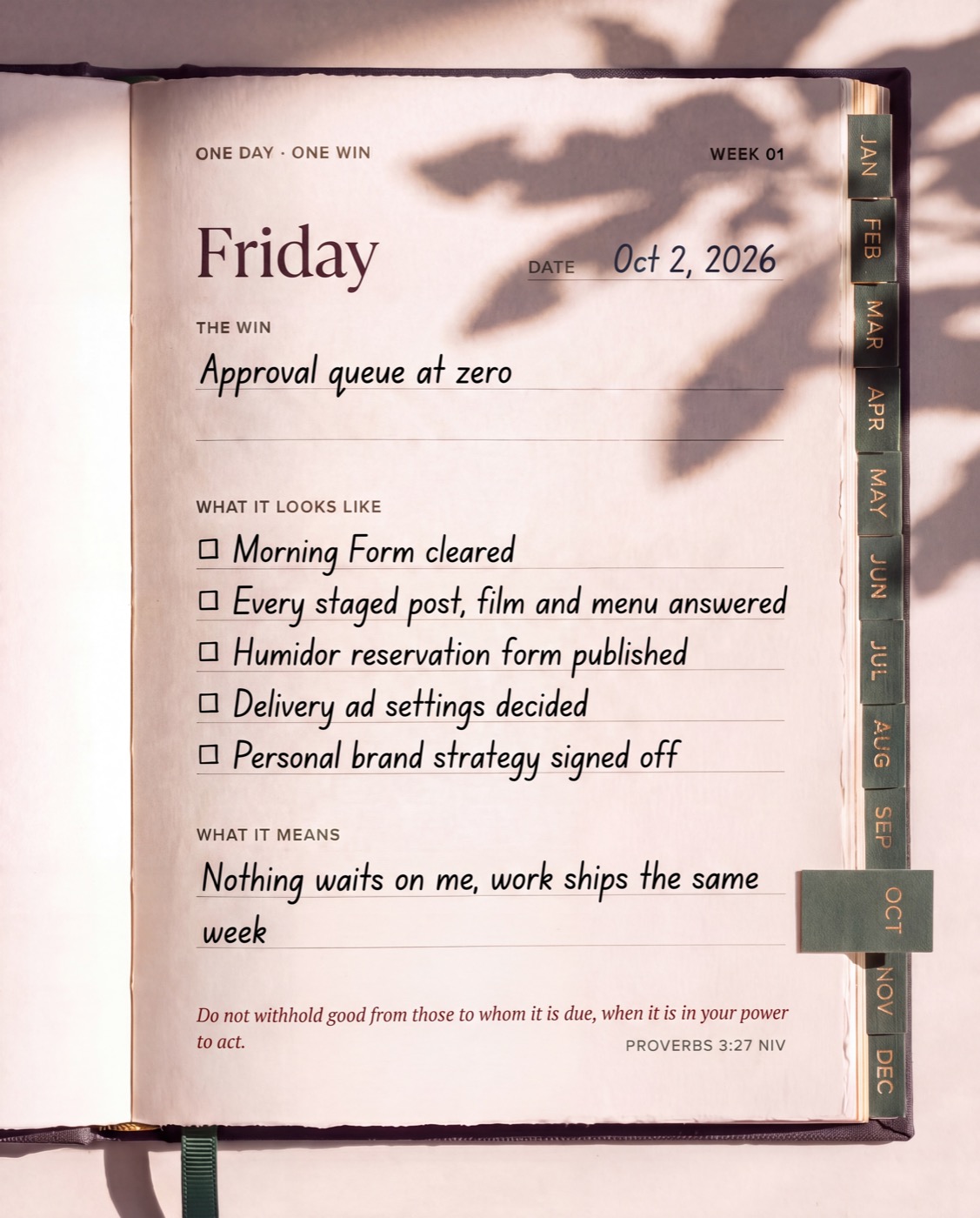
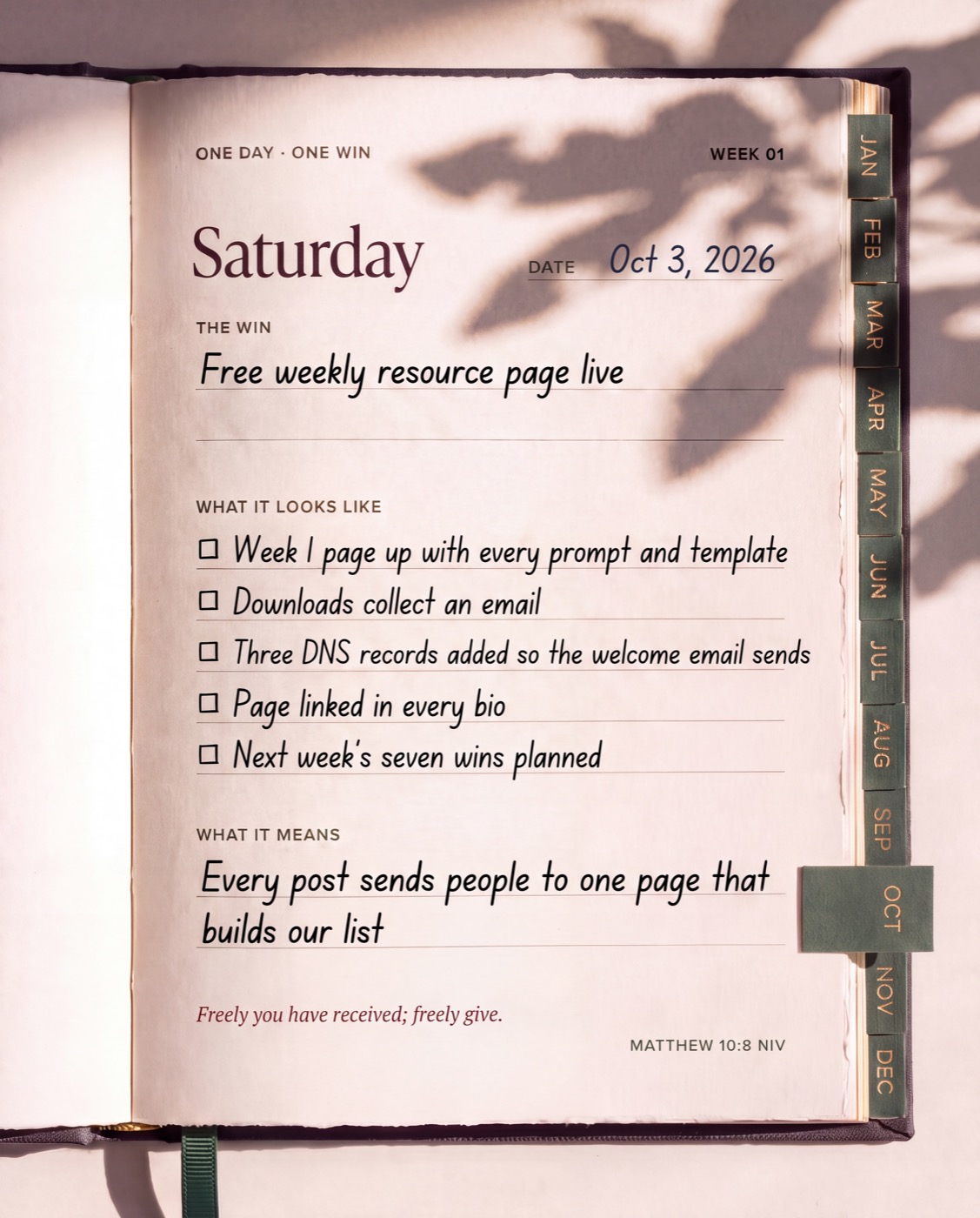
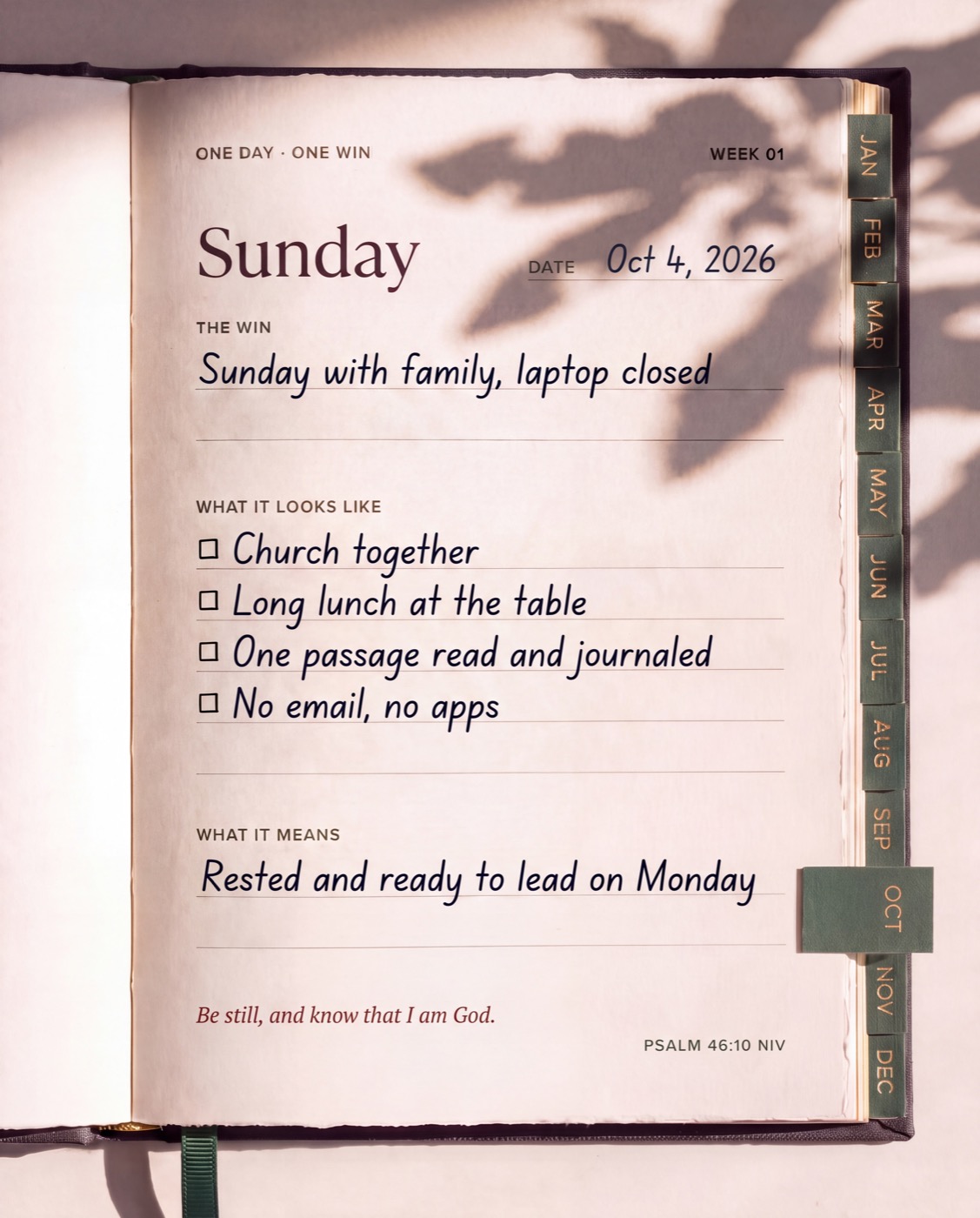
Pages illustrated with Nano Banana Pro from my written plan.
The blank page
A printable week, a page for each day. Letter or A5.
Questions
Do I have to own a business?
No. The prompt says "in my business or my life." A win can be finishing a room, having a hard conversation, starting a workout plan or getting a school project turned in. The three lines work the same.
Which app should I use?
ChatGPT or Claude. The free version of either one works. Start a new chat so older conversations don't get mixed in.
What if I don't know what my week looks like yet?
Give it the messy version: "Payroll, need to hire a cook, kid's game Thursday, inventory is off." The prompt sorts it into days and asks up to three short questions where things are vague.
Why only one win a day?
One win you finish beats five you start. You'll still do other things. The win is what gets your best hours.
What if I miss a day?
Move it or drop it. Don't stack two wins on tomorrow. A missed win is information: it usually means the win was too big or the day was already full.
What about my rest day?
Tell the prompt which day you rest. If you don't, it uses Sunday. Rest counts as a win, and it gets a page like every other day.
How are the verses chosen?
From the verse list at the end of the prompt. It is grouped by theme: planning, work, finishing, money, generosity, team, wisdom, courage, worry, rest, family, health, integrity, gratitude, new starts, focus and customers. The prompt is told to pick the verse whose meaning fits the day's win, never repeat one in the same week, and never quote from memory. Check each one in your Bible anyway.
Can I skip the verses?
Yes. Tell it "no verses" and it leaves that line off.
Can it make the pages as images?
Yes, if your chat tool makes images. Ask for one page at a time. Image tools still misspell words, so read every word before you print or share a page.
Should I put private details in?
Keep it general. Say "the new hire" instead of a name and "the bank call" instead of account details. The pages work just as well.
Does the prompt send my information anywhere?
No. It runs inside your own ChatGPT or Claude account, like any other chat. Nothing you type comes to me or to this site. Only the blank-page form below asks for anything, and that is just your name and email.
Can my team use it?
Yes. Each person plans their own week with it. Managers can also use the three lines in a weekly check-in: what was the win, what did done look like, and what did it change? It keeps the conversation on outcomes instead of hours.
Is this really free?
Yes. The prompt is free, and you don't need to give an email to use it. If you want the printable blank page, leave your email below.
Can I share it?
Please do. Send people to andrewsteakley.com/win so they always get the current version.
Read the full guideWhy wins beat to-do lists, the three lines, a messy week turned into seven wins, and common mistakes.
How to use it
- Copy the prompt. Tap the Copy button at the top of this page. It copies the whole thing, verse list included.
- Paste it into ChatGPT or Claude. Start a new chat. The free version of either one works, on your phone or your computer.
- Answer its questions. It asks what is on your plate this week and which day you rest. A messy list is fine. Short on time? Type "just do it" and it writes all seven pages right away.
Most people get to their pages in two or three replies.
Why one win beats a to-do list
Most weekly plans fall apart by Tuesday. The list is too long, everything on it looks equally important, and by Friday you have crossed off a lot of small things and finished none of the big ones.
I run businesses in downtown Waco. There are always more things to do than hours to do them. A better app did not fix my weeks. A longer list did not fix them either. What fixed them was deciding, before the week starts, what one thing each day has to produce.
One win per day does three things for you.
It forces a choice. You can't pick seven wins without deciding what matters most this week. That decision is the hard part. It is better made on a quiet Saturday morning than at two o'clock on a Wednesday with something on fire.
It gives the day a finish line. A to-do list never ends. A win does. When the boxes are checked, the day did its job, even if other things are still open.
It shows you the week. Seven pages side by side tell you whether you planned a real week or a wish list. If Monday through Saturday all say "catch up," you know before the week starts, not after it ends.
The rest of the list doesn't disappear. Email still gets answered and the phone still rings. The win is simply the thing that gets your best hours.
The three lines on every page
Every page has the same three lines. Each one has a job.
The win
One clear outcome, ten words or fewer. Name the actual thing.
- Weak: "Marketing."
- Better: "Brunch promo written and three posts live."
If someone else read your win, they should know exactly what you are trying to get done. "Work on the website" is an activity. "New menu live on the website" is a win.
What it looks like
Three to five boxes you can check off. These are the things you would actually see when the win is done. Not feelings, not effort. Things you could point at.
For "New menu live on the website," that might be:
- ☐ Prices checked against the register
- ☐ Photos swapped for the new dishes
- ☐ Menu page updated and tested on a phone
- ☐ Old PDF menu taken down
If you can't write the boxes, the win is still too vague. Go back and sharpen it.
What it means
One line on the real difference it makes. This is the line most people skip, and it is the one that matters most.
If you can't write the third line, it isn't a win. It's a task.
"What it means" is how you find out whether a day deserves your best hours. "Inbox under 20" means less stress. "Catering inquiry answered today" means the lead doesn't go cold and you might book the party. The second one is the better win, and you only see that when you write the third line.
Keep it plain. No slogans. Write it the way you would explain it to a friend across the counter.
The verse
At the bottom of each page I write one verse that fits the win. My faith is the reason I do the work, and one verse is enough to remember that when the day gets loud.
The prompt picks each verse from a short list of NIV verses printed at the end of the prompt, and it is told to copy them exactly. Chat tools are known to misquote scripture from memory, so the list keeps them honest. Even so, check each verse in your Bible before you print or post a page.
If the verse line isn't for you, tell the prompt to leave it off. Everything else works the same.
From a messy list to seven wins
Here is what a real Monday brain-dump tends to look like for someone who runs a small restaurant:
marketing stuff, catch up on emails, schedule is a mess, need to hire a line cook, health inspection sometime soon, kid has a thing Thursday, inventory's off
Nothing on that list is wrong. It just isn't a plan yet. Here is how the prompt turns it into one.
Pick the day for each thing. Hiring goes early in the week so interviews can happen before the weekend. The kid's event goes on Thursday, and Thursday's win gets smaller to make room for it. Inventory goes on the slowest day.
Turn each item into an outcome. "Marketing stuff" becomes "Brunch promo written and three posts live." "Catch up on emails" becomes "Catering inquiry answered and inbox under 20." "Need to hire a line cook" becomes "Line cook job posted and three interviews booked." "Inventory's off" becomes "Full count done and the three biggest gaps found."
Write what done looks like. For the hiring win: the job post is written, it is live on two job sites, the current cooks know to send referrals, and three interviews are on the calendar. Four boxes. Anyone could check them.
Write what it means. "Weekend shifts covered without the owner on the line." Now the day has a reason, and you know why it's worth your best hours.
Be honest about the day. Thursday has a family event at five, so Thursday's win is one clean thing that can be done by three: "Health inspection checklist walked with the kitchen manager." Planning a smaller win for a full day is a wise call, not a weak one.
Common mistakes
A win that is really a project. "Launch the new website" is a month of work, not a day. Break it down and give the day one piece: "Home page and menu page written."
Boxes that are feelings. "Feel caught up" can't be checked. "Inbox under 20" can.
Seven wins about work. If every page is about the business, the week will take more than it gives. Put at least one page toward the people at home, your health or your rest.
Planning the week you wish you had. If Tuesday is payroll and ordering day, Tuesday's win has to fit around them. Plan the week you actually have.
Skipping the third line. It's the fastest line to write and the easiest to skip. It's also the one that tells you if the day matters.
Never looking back. The pages only get better if you check them on Saturday before you plan the next week. What finished? What slid? Why? Two minutes of looking back is worth an hour of planning.
Look at the mix. Two days are about money coming in or going out. One protects my managers' time. One finishes a long project. One clears every decision off my desk so the team isn't waiting on me. One builds something new, and one is rest. Seeing seven pages side by side is how you spot a lopsided week before you live it.
How to run the week
- Saturday or Sunday: plan. Run the prompt for the week ahead. Give it fifteen quiet minutes.
- Each morning: read the page. Before email. It tells you what the day is for.
- Each evening: check the boxes. Honest checks only. If a box didn't get done, write one line on the page about why.
- Rest day: rest. It counts as a win. Plan it like one.
- End of the week: look back. Which wins finished? Which ones slid? The ones that slid tell you what to plan differently next week.
New pages every Monday.
InstagramFacebookLinkedInTikTokThreadsXYouTube
Want help building your business this way? Coaching at Bennett & Howell →
THE HOLY BIBLE, NEW INTERNATIONAL VERSION®, NIV® Copyright © 1973, 1978, 1984, 2011 by Biblica, Inc.® Used by permission. All rights reserved worldwide.